ResponderSafety.com Podcast

The Emergency Responder Safety Institute presents the ResponderSafety.com podcast, a closer look at hot topics, new information, innovative approaches, and case studies in responder safety at roadway incidents and in traffic incident management. Listen for practical, actionable information you can implement today at your next roadway incident response to improve safety of emergency response personnel and the public, no matter which agency you work for. Come learn from interviews and special features with experts and leaders in emergency services. All agencies who respond to roadway incidents — fire, EMS, fire police, law enforcement, DOT, safety service patrols, special traffic units, medevac, and towing and recovery — are all welcome and will find value in what we discuss.

Rod Ammon: Welcome to the ResponderSafety.com Podcast brought to you by the Emergency Responder Safety Institute, a committee of the Cumberland Valley Volunteer Firefighters Association. To remain mindful of why we do this work, we start every podcast with an update of emergency responders struck by fatalities. As of September 18th, 26 emergency responders have been struck and killed this year while assisting the public on the roadway. We have information on the loss of these responders and a memorial tribute available at respondersafety.com/fatalityreports. Our thoughts are with the families and their colleagues. Please visit respondersafety.com for more than 150 resources and training modules that will help you operate more safely at roadway incidents and educate the public about how to safely avoid or pass an emergency scene on the roadway. If you're aware of an incident where an emergency responder or emergency response vehicle was struck while working a roadway incident scene, please report it to us at reportstruckby.com. Your reports provide crucial data that will help us identify why struck-by incidents occur and design new training and resources to mitigate those contributing factors. You'll remain anonymous if you like. Today's topic is traffic incident management at intersections. When we talk about protecting responders from oncoming traffic, our minds usually go to that high speed highway, but intersections carry their own significant risks. With us today to explore this topic is Battalion Chief John Bennett of the Seminole County Fire Department in Florida. He's a 25-year veteran of the fire service and his areas of expertise include human performance, project analytics, and organizational collaboration. He focuses on officer development and creating team-based high performance through operational frameworks and empowered decision making. During his 15 years as a company officer prior to promoting into his current role, Chief Bennett developed a framework for traffic incident management at intersections because he felt the intersection context was not addressed in existing TIM guidance and that posed a safety risk to his crews. Chief Bennett is here to talk about why intersections are different and how his crew sets up traffic incident management areas at responses in intersections. Chief Bennett, welcome to the podcast.

John Bennett: Thank you, Rod. I appreciate it.

Rod Ammon: Well, we appreciate your insight today. So you describe your approach to operations as a process guy who uses frameworks. What do you mean? How do you build out the organization of tasks for your crew?

John Bennett: Through mistakes. That's the best way to figure it out. Every time you have something, you make note of it, whether it's mental note, verbal note, conversational, or ultimately putting it down on paper. Over time, that's what experience really is. It's taking all these mistakes, what I should have done, what I could have done, what I would've done, and starting to put them together. So through experience, it just becomes a matter of, hey, rather than just having this jumble of ideas, let's actually make something out of it. Let's actually make it more systematic and it makes it easier to teach so others don't have the same long learning curve. They can come right into it.

Rod Ammon: Sounds like a pretty direct process instead of going through all of... I appreciate the simplicity of it. So while building out your frameworks for responses on roadways, how did you come to realize that intersections were an issue and different?

John Bennett: It wasn't a single moment, nor was it even an intentional effort. It was just paranoia on the roadway. It was realizing between we have a toll road in our first due where I was as a company officer for 15 years. Actually, I was in that jurisdiction for 12 years, but along with two major surface street highways. So we spent a lot of time at these intersections of both the major roadways as well as major with minor roadways, and it was different every single time of having to keep your head on a swivel. So we just started building things out little by little of, "Hey, let's do this a little better next time," just like anybody does in the fire service. Ultimately, it came down to realizing that we needed to actually structure this because as new personnel came in, as personnel evolved through the house, trying to reestablish this just became too much explanation and not enough operational establishment.

Rod Ammon: Where did you go from there? What was your framework for setting up a traffic incident management area at the intersection and how does it look different than, for instance, a TIMA or a non-intersection road segment?

John Bennett: Yeah, so the main concern with intersections is that where freeways and highways on a typical TIMA are in linear directions because we're concerned mostly about traffic coming from behind us, just one direction. You do have the crossovers the opposite direction you have to be concerned about, but it's a little bit lower priority in many cases, and we're not actually having to block it. An intersection, just like NHTSA shows in some of its videos have, I think it's somewhere in the vicinity of anywhere from 30 to 60 points of contact that can occur. So those are places where traffic can cross one another. Those are also potential collision points adding the additional incident in the middle. I began to realize with a little bit of a military background with family, friends, and some youth experience that we had our head on a swivel constantly. And one main priority in the military, say for example, digging a line of foxholes, old school, each foxhole has its own firing line. There's a range that they're supposed to focus on, and it's not just a matter of what can we cover and keep our back on. It actually comes down to science, and 60 to 100 degrees is about that best periphery that you can keep track of. They use the same thing in law enforcement with SWAT approaches. Each person wants no more than a hundred degrees of focus, and they try to keep it as narrow as possible. Well, here we are on this broad intersection with literally threats coming at us from all ways, and we're turning our head from one side, 180 degrees to the other, 90 degrees back behind us, trying to keep our eye on things. So it was a matter of how can we trim this down so that way a company officer, whoever has the safety of the scene, has much less to focus on? And that's where it all started, was trying to form that protective barrier to work inside of.

Rod Ammon: I love it. I love the way you described, and sometimes it's frustrating that we're in audio, but the way you described it is how many different points of contact or potential issues there are in so many of these different intersections, and those are getting crazier every day. We can talk about that later. Why don't you give me a specific... You said you learned from mistakes. Can you think about one of the situations in the back in your history where you thought, "Wow, we got to think about how we do that"?

John Bennett: On the initial editorial on respondersafety.com, the missing map at our intersections where we outlined the objectives of it more than anything, there's a photo at the bottom where we've positioned an intersection on a three vehicle incident, and the engine is placed very well off to the side where it's protecting what we call the open side of the intersection, the high speed coming from the furthest direction where people don't have visualization. And the rescue parks opposite that, the rescue being the medic unit, the ambulance, as we refer to them in Florida mostly. And it's protecting itself. We want to protect that patient compartment. We want to keep everything secure. So they're in a very low frequency area off to the right side in the turn lanes, which is great. However, very clearly from the angle of the camera, as you're looking at the photo at the bottom, it is clear that this is another open intersection where vehicles can just come straight into our scene. Now, usually by the time we get there, traffic slowed down at a lot of intersections, but if you don't have enough traffic to congest to slow everybody down, too many people are on the road doing their own thing. A very similar incident to this photo is where somebody came directly through, they just saw their green light, didn't pay attention to anything else, and they came into nearly a screeching halt right in front of one of the cars. I'm just glad none of our people were on that side at that point in time. We were on the opposite side and everybody looked up and it was kind of that very dead silence of a deep breath, and then of course the firefighter fury and anger that came out from it. And that was one of those, it was just like, "Okay, this can't happen again."

Rod Ammon: How do you prioritize your response? Often, it seems like in intersection situations like this, you'd have limited apparatus.

John Bennett: Yeah, so just like anything in the fire service, we try to establish the slowest smooth, smoothest fast, and so often we get to that intersection and we get in a rush to put that apparatus in place, get out and get moving, as opposed to, similar to a structure fire where we need to get out, make a 360 or a good extrication, make a double set of 360s, we need to do the same thing with our apparatus as we approach the intersection. We need to be able to approach slowly and be willing to make a big turn and circle if we need to use the whole intersection or other areas to reposition that apparatus for best case scenarios. Now, that can't always happen. Sometimes there's too much congestion or the position of the incident. We can't get it, but we want to have that ideal. So the first is slowing down as we approach with the apparatus. The second is just like anything else, training and understanding our anatomy of a situation and our anatomy of a structure beforehand. We want to understand the anatomy of an intersection. And through this project, we've defined what the anatomy of an intersection is from several standpoints, including breaking it down. And we'll just talk about a basic intersection. We'll say a four-lane road intersecting with a four-lane road, whether that's stop signs, traffic lights, both directions or one direction. An intersection is just that. We break it down into quadrants: alpha, bravo, charlie, delta, just like we do with a structure. And we start with the alpha, is it the direction I come from? Is it where I place my apparatus? Well, all those variables can change. So what we do is we prioritize the primary location of an incident, which quadrant of the intersection as these two roadways intersect one another is this incident placed in? And that's alpha. And then we go clockwise from there, bravo, charlie, delta, and it helps us both understand where we need to be as well as where the threats are and communicate with incoming apparatus where they need to be. It also helps for incoming apparatus without communication, understanding as they look at the intersection, if everybody's trained well on this, exactly where to position themselves next. So the first is being able to visually, we call contain the scene as you approach, slow down, let's see the whole scene, let's not miss anything. Understanding that breakdown of the intersection into the quadrants and then identifying the highest risk areas. The work that responder safety has done over the last 20 plus years has created standards in operating procedures across the country. And between the standard policymakers that are out there, the big known policymakers that most departments pull their stuff from, when it comes to intersections, the strongest thing out there and all the research that I've done across the country talking to departments, looking at their SOPs and their operational standards is protect the intersection from the most dangerous side, and that's as specific as it gets. I have yet, and I'm sure it's out there somewhere, and I hope at some point somebody who has developed strong policy can help share what they have. There's nothing more specific than that. So we had to start going, your opinion of what the most dangerous part of the intersection is, somebody else's opinion, two different roadways, different resources available to organizations, that can all vary. So how can we objectify this? Not that it has to be this is the only way it is, but where do we start from? So we started looking at it and oftentimes apparatus position the closest place to traffic in an intersection. So let's try to visualize two four-lane roadways coming together and we'll put the incident very tightly in the upper right-hand corner just in this incident. A lot of times apparatus will position right there where the traffic is on top of them, which makes sense, and it can be a primary position to block from. But the reality is, is whether it's this intersection or one that's eight lanes across on both sides and the open area in the intersection is 300, 400 feet across, individuals don't drive visually very far beyond their hood. They're focused right in front of them. So when they enter an intersection, they're often not paying attention to what's on the other side. VFIS has a citation in this in part of their training of being able to recognize the far curve that's for operating apparatus, driving apparatus, and that's very true for intersections is we have to train our people to look at that far place and everyday person who is so distracted by the many Ds is not going to be paying attention to the other side of that intersection despite the big red trucks and bright lights. So we want to position our apparatus to block from that what we call open side, that far side approach first, because that's the most risky area where somebody's probably not going to notice us and going to notice us way too late. And then secondly, you want to block that close side, the one that we initially want to block. And what we've done there is we've taken out the two primary approaches to this quadrant, both the one that's close and the one that's farther away but more hazardous. We've also put the apparatus in somewhat of an L shape now if you visualize that because they're two perpendicular approaches, and so they're positioned perpendicularly forming an L, that goes back to the very first concept we were talking about of being able to have that narrow scope. Now the company officer, the safety officer, whoever it is, can sit inside that L, whether it's on the very inside or on the edge of it, and be able to look in just one range of directions, and the apparatus are covering the backside. So that's kind of the system that helps us approach, evaluate, analyze, and position. And all this has to be... We have to understand upfront, you can't just train it on the roadway, you have to know these concepts beforehand, especially the anatomy and especially the positioning in order to make that slow approach turn around, wrap, and contain the scene at the intersection beforehand or when you arrive there, you need to know it beforehand.

Rod Ammon: So help me clarify. So your first position, the further away position, you're actually slowing traffic to the area?

John Bennett: It definitely can, or at minimum, you've now created a wall, you've created a barrier. So whereas in highway positioning and freeway positioning, we're usually just giving ourselves a little 30 degree angle, if not possibly somewhat parallel with traffic. In these positions, we want to be 100% 90 degrees to traffic. We want a wall. We don't want anything being pushed into our incident, and we don't want anything to be running along it. We are creating a 90 degree wall as best we can. A lot of times we're going to be at as much of a 45 degree angle.

Rod Ammon: You've described this, I think, earlier when you were talking with Cathy about eliminating sneak points. You want to talk about that a little bit?

John Bennett: Yeah, so there are two kind of sneak points. There's both the involuntary sneak point and the voluntary sneak point. The voluntary sneak point's the easy one to address. We've all been there in the roadway where we kind of put our apparatus in position, we maybe even lay our cones out, and this suggested traffic which direction you're supposed to go. Well, they're not trained as us, and they also don't care as much as we do. They've got places to go and they see a way to get through, and they're going to sneak between these cars, these cones, these apparatus to get where they want to go. They're not going to follow what's being suggested to them, and the number of times they pull up, roll down their window, and, "Can I get through?" When every other car before them did not go through. So especially if we're not paying attention, these cars just do whatever they want. There are some people who are just unaware and they're trying their best, and there are those who really are just blatantly don't care, and that can be very harmful to us, especially when we have our backs turned to a particular direction. So this approach helps eliminate some of those sneak points, those voluntary sneak points. The involuntary sneak points are those where we leave gaps. On linear positioning on a limited access freeway, for example, sometimes we don't put our tailboard into that shoulder lane enough or into that median shoulder enough, and a car traveling at high speed who wants to veer, two and a half feet is enough for them at 60, 70, 80 miles an hour to plow right past and move that apparatus out of the way directly into our scene. So in this same instance, when we put these apparatus together on surface streets in that L, we want to tighten that L up because we want to make sure that there's not a three or four-foot gap where they want to either voluntarily or just not paying attention, plow right between them and dance those two apparatus apart. We want them to be tight to where if they're going to hit them, they're going to hit them and it's going to protect us just like a wall barrier. So those are two types of sneak points that we're trying to eliminate. There's a video from, I think it's the late '90s, and I've tried to find it again, but I haven't been able to. It was shown in EMT school, it was shown in fire school, and I've seen it other places since, but probably not in the last 15 years, of a trooper who's pulled off to the side of a small wreck of a car next to a box truck, and he's talking to them. It's an old grainy video, getting ready to move them off the roadway, and these two, they're in the two lanes right next to each other, just linear with traffic. So what is there between them? Maybe two or three feet, and you see the trooper suddenly look up and panic and run, and this car just comes plowing right down the middle and splits the box truck and the car right apart, and the trooper just made it out of the way in time. So those are similar sneak points of just leaving gaps that invite accidental mishaps to occur.

Rod Ammon: Yeah, I think I've seen that video, and no matter how many times you see it's sort of like, "Wow." The speed is brought directly to you quickly through that point of view. There are so many options we're talking about, and I don't think we can be here trying to train people during a podcast how to do this. So I'd like to do a couple things. I mean, first of all, there's so many options for so many different types of intersections.

John Bennett: It's endless.

Rod Ammon: Yeah. What do you do... You've broken this out, you've taken a systematic approach, and what do you do to train your people? Are you doing it live? Are you doing pre-planning with intersections that you know are a problem in your area, tabletops? Maybe you can share a little bit of that with us so others might be able to pick up from it.

John Bennett: Yeah, so from the beginning for us, it was organic because we were developing these ideas together over a few years, and then it would come to having our new personnel at the station during their probationary periods, and it was everything from whiteboards to showing how to break down the intersections, to what the crews really enjoyed doing was we have a big firehouse table, and they would take masking tape and make a roadway across the whole table, and we usually do four lanes in both directions, and they'd lay this out and take some sticky notes or some cards or something and make just real quick, cut them up, make fire engine size, rescue size, and car sizes, and they'd throw a couple cars in the intersection and they'd say, "All right, show me where to put the apparatus." And through trial and error with the new personnel, we would say, "Okay, that makes sense. Let's take a look at the gaps where the problems might be." Experience, that's a big deal, it's experience. Oh, okay. Now they can see it because they're seeing it from a bird's eye view, from a three-dimensional view. And at times, we'd even get them to, when they don't see it or trying to let them see it on their own, actually crouch down to the table level and look at it from the roadway level, and then we move everything around and we position these, and when we didn't have new personnel, we'd do the same things together during our training time. And so over time, it just evolved in that fashion, and by the time the rookies were well established at the house, they were training the other rookies and they understood it. And it got to the point where, yes, I was probably leading most of it for the first five to seven years. I mean, I'm the company officer as well, so I have a little bit of a different perspective on it, to by the time I was leaving, I was standing back watching, and they were directing it. I'd only intervene once in a while or they'd just, "Hey, Lou, what do you think? Do you see anything?" And just leave them hanging and let them own that responsibility a little more. So that was one of the best ways. Sometimes they would take sticky notes and they found it's a little faster. Laying out tape on the table seems quick, but it actually takes about 20, 30 minutes to set up. So they draw it on the board and use sticky notes on the whiteboard a little bit easier. It just doesn't give the same three-dimensional approach, but it does help with teaching concepts.

Rod Ammon: I've seen a lot of people work with tabletops, and in the past, they were so effective that we actually shot some of what they were doing with the tabletops, and I'm probably aging myself, but they had their Hot Wheels type cars, lowering the cars and the fire engine. And you reminded me of it because you said sometimes we have them lower their eyes down to the tabletop level, and I thought that's really where having those 3D cars or something would be so helpful. I guess maybe you got to use Origami or something to get some more dimension out of your Post-it notes, but I'm just trying to think of what are the best ways to do something like this. As you said, that takes quite a bit of time to set that up. So what are some of the things that people can do to make this a regular thing? I love the fact that you all went out and took this time, and it sounds like, as you said, people are enjoying it. I'm thinking also cooperation. I'm thinking about TIM committees or working with your local law enforcement or dealing with the communication of this, because again, some of it's sort of newfangled, shall we say? If it's not being dealt with in TIM and we're having all these new types of intersections being created, how are you dealing with that? How about the communication with the others, the towers, the police?

John Bennett: Yeah, so we're pretty spoiled here in our first response system with fire department, so we play really well together for the most part, even those adjacent counties that we don't necessarily have immediate first response agreements with. So the best follow-up is on the roadway once things are calmed down, is being able to sit back with everyone and say, "Hey, look at this." Most people are pretty receptive to a conversation. Working with law enforcement is a little bit more of a challenge. We've actually put together a proposal to work with our local agency to be able to try to work this out, but there are just so many things on the training table that it's hard to fit these in. So we just try to work little by little. We have nothing formal for ourselves. Some of those agencies who do have good interorganizational work probably would find that very beneficial, especially those where law enforcement tends to own the scene to quite an extent first. We don't have very long to wait for apparatus in our jurisdiction. We have a couple of rural areas where if they need a third or fourth apparatus, it could be 10, 12, maybe 15 minutes at most. But for the most part, we're providing it to other jurisdictional areas. We're providing our apparatus. So we don't have much of a want here, and I recognize that's not common. A lot of people are simply restrained by it. Working on those TIM committees I think is great. I know Louisiana does quite a great job outside of everybody else up in the Northeast who has some good work. I think that's for the most part, if I remember right from my conversations, led by the state police, if I remember correctly.

Rod Ammon: Yeah, it really depends, and I'm not going to be the expert on it, but the ones that I've seen, it almost works like a consortium. Nobody's really taken a lead, but somebody is facilitating the meeting and then they get into conversations and they talk about situations and who's going to do what.

John Bennett: I think it's kind of almost regional, whether it's this is a great buy-in for us or not, you need lots of people. So if just a couple of agencies say, "Hey, we want to do this," it doesn't seem like it's going to last very long, but it does seem to be somewhat social regional, if I can say, that it's either, "Hey, we do our own thing. We don't need these... We already have enough inner collaborations that we don't need to add this. There's enough training out there. We'll get it from there," to areas that are very heavy on making sure that this is a top priority on working together and being on the same page.

Rod Ammon: You know us crazy northerners, we need more meetings because there's a lot going on. Yeah, I mean, when I think about these scenes and how many different players are showing up at that scene, and then I went into a TIM meeting or a TIM committee, it was enlightening, and I think a lot of it, maybe, as you say, it's regional, but a lot of these folks didn't get to meet each other except on the road. So having some communication before was incredibly valuable, and you're talking about another great time right after something that's happened. I'm guessing though that there's often a rush to terminate the scene and to move on.

John Bennett: 100%. And I think that rush too, like you were alluding to tow personnel that are often left out of this picture, we leave and we leave them and law enforcement to do their thing often without any large blocking apparatus because we are limited in our resources and agencies are also graded and evaluated based on their turnaround times. And if their apparatus are stuck on this scene waiting for a tow that doesn't absolutely require a block, they're leaving. So the tow operators are getting left out of this whole picture as well. I know that's a very sore spot for Jack of trying to make sure that we have a whole picture.

Rod Ammon: I hear people talking about it more than ever before, and I've seen it where we're supporting our brethren in the towing world, so you can only hope that the protection of those folks gets better and better as time goes on. I really am hoping that we can send people to more training about this. I mean, at Responder Safety Learning Network, we obviously have things about the team and whatnot, but some of the new things that you're doing, what are you doing to document that and to share it with others?

John Bennett: Yeah, so Responder Safety obviously has been the big hurdle that help get this organizational part started out there. In November, fire engineering will be releasing the article that more spells out the fundamentals of the process. And like you said, it's endless. So we can't cite every single scenario out there, but it gives a benchmark start. And hopefully in the future between hopefully presentation opportunities, additional articles, and maybe some video opportunities, getting a chance to train that and teach that out there and seeing what type of reception there is to what more do people want to hear, what are they asking for, where are the shortfalls? And being able to read it from there as to exactly what more should be put out there rather than trying to put the cart before the horse.

Rod Ammon: I like it. Well, Jack would be upset with me if I didn't bring up roundabouts once before we took off in our own ways. What are you thinking about roundabouts? I mean, I'll tell you, they're real and they're all over the place. And now because Jack has brought it up and you and I have had a short discussion about it, I really start thinking more about, wow, what would you do?

John Bennett: Yeah, I've wrestled with this a couple times. I've sketched it out on the back of a paper a couple times and I'm going, "Roundabouts really do eliminate a lot of this need." There is definitely an intersection right there, but it's a very soft intersection. For the most part, you treat it as where that roadway comes into that circle, it is treated as a three-way intersection. Our minds just kind of freeze up in this Euro style of what do I do on the right side of the car with the steering wheel over here? But really just straighten that circle out and you see that it's just a series of T intersections. And so we treat it the exact same. I did sketch something out, so I was kind of hoping to surprise him in early spring maybe of putting something out there for a proposed article on locking it roundabouts.

Rod Ammon: Well, he'll love that. I'm thinking about all of your experience. There aren't a lot of people who have the number of years of experience that you do and have had this much focus on roadway or at least the analytical part and thinking about the way you do with frameworks. Since you're an analytical guy, what are some of the other big takeaways you want to share with folks before we go about roadway incident scenes based on your experience?

John Bennett: It's funny, Rod, we had a 15, 20 minute meeting and you've read one thing, we've had this, and you've already call me analytical. It takes some people 20 years and they're like, "You're really an analytical guy." I'm like, "I am not. I am not."

Rod Ammon: Well, first of all, Cathy has a lot to do with that because she had conversations with you and I also had a brief conversation with you. And anybody who thinks through these things to me, it's just good news for the fire service.

John Bennett: I appreciate it. My main takeaway is I think being able to slow down and put a system in place. Whether you agree with this system, you use, adopt, adapt, any of it or anything that you're already doing is to be able to slow down and have something that's consistent. And I think that's what keeps us safe for the most part is consistency in our operations. It also helps us when we have consistency of any kind of framework to see the gaps, the gaps in the situation, the gaps in our operations and the gaps in possibly our personnel. Without that, everything kind of becomes hodgepodge. So slow down and implement your systems well and consistently.

Rod Ammon: I love that and I love it as a close. Slowing down makes you faster or more responsive anyway. Makes me think about them. I think it was Mario Andretti who used to tell people he could beat them across New York following the lights just by timing everything right. He'd let them speed. I don't know whether it's a myth, but it was an interesting story anyway. I appreciate your time, Chief Bennett. We haven't seen much about this topic, so it's really good I think to explore it and we appreciate all the time you spent doing so and creating protocols to safeguard people. I get this feeling because I met you, you came all the way up north to receive an award from the CVVFA and well deserved and I am grateful for your time and I have a feeling we're going to see and hear from you in the future. Will we?

John Bennett: If there's an open door, absolutely.

Rod Ammon: I appreciate your thought process and all of us appreciate your time.

John Bennett: I appreciate the open doors and the warm welcome. Thank you very much for the support, Rod.

Rod Ammon: Thank you, man. You have a good day and a great weekend.

John Bennett: You as well.

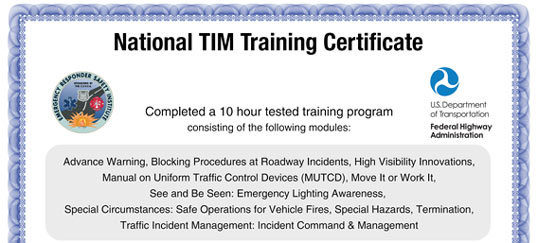
Rod Ammon: Be well. Thanks again. Now for the news from respondersafety.com. Two Responder Safety Learning Network modules have been fully revised and updated for 2026. The new Manual on Uniform Traffic Control Devices 11th Edition Module updates the training content for the new edition of the MUTCD released in December of 2025. This is an important update to keep your knowledge current and ensure you are in compliance with the MUTCD's traffic incident management provisions. A second module, Personal Protective Equipment for Roadway Incident Response 2026, has been revised to reflect the new ASTM E3422 standard on design of a pedestrian roadway worker helmet, as well as updated recommended practices in personal protective equipment. Links to these two modules are on this podcast page at Responder Safety Learning Network. Take these modules today to bring your knowledge on the MUTCD and Personal Protective Equipment up to date. Finally, in May 2026, the Texas Commission on Fire Protection revised Texas Administrative Code Chapter 435, Firefighter Safety 435.29, that previously required fire protection personnel to complete the Federal Highway Administration's Traffic Incident Management Program training or an equivalent course approved by the commission within one year of appointment to a regular entity. The revision adopted at the May meeting added a new clause that requires completing the TIM training program at least every five years. By 2029, all fire protection personnel must be compliant with this new five years requirement. The National TIM Training Certificate available online from the Responder Safety Learning Network, rsln.org, is accepted by the Texas Commission on Fire Protection as equivalent to the FHWA TIM program. All fire protection personnel can use RSLN's National TIM Training Certificate to fulfill the Texas Commission's new refresher TIM training requirement. If you have completed RSLN's National TIM Training Certificate before, you can complete it again to refresh the date on your certificate. A link to an article on how to refresh multi-program certificates is available on this podcast page on respondersafety.com. That's all for this episode of the ResponderSafety.com Podcast. Remember, if you know of an incident where an emergency vehicle or a responder was struck while operating at a roadway incident, please report it at reportstruckby.com. We're collecting these reports for better understanding of how struck-by incidents occur so we can determine what training, public education, and safety messaging is needed to reduce struck-by incidents. Anyone can file a report. You can report anonymously. Reports from all response groups are accepted. Connect with us on social media for timely updates on news and emergency response at respondersafety.com activities. Like and follow us on Facebook at facebook.com/roadwaysafety, on Instagram at instagram.com/respondersafety, and on X at x.com/respondersafety. This podcast, ResponderSafety.com and the Responder Safety Learning Network are made possible by funding from a Fire Prevention and Safety Grant from the Assistance to Firefighters Grant program administered by FEMA and the US Department of Homeland Security. We appreciate your support and remember to share these podcasts with your colleagues to spread the word about safety practices at roadway incidents. Thanks for joining us today on the podcast. Stay safe, everybody. We'll see you next time. For respondersafety.com, I'm Rod Ammon.

2026
Powerful Words from an Emergency Responder: Tragedy to Triumph - On March 17, 2014, Powhatan County Sheriff's Deputy Brad Hughes was struck by a distracted driver while assisting the Chesterfield Police Department at the scene of a 17-car pileup during an ice storm.
Episode 16: Blocking Vehicles with Victor Conley - Victor Conley has been with Irving FD since 1986 and was appointed Fire Chief in 2014. He supervises over 430 employees and a budget of more than $75 million. He has served the department in many capacities, including high angle rescue technician, HAZMAT technician, training officer, paramedic, and dispatch supervisor. Irving is large, busy city of 250,000 in the Dallas-Fort Worth metroplex.
Episode 15: Seatbelts with Christy King - Christy King’s son, Christopher, was killed in a car crash on July 4, 2020, shortly after he graduated from high school.
Episode 14: Jamie Drawbaugh and Interacting with the Public - On June 12, 2023, Chief Jamie Drawbaugh of the Montgomery County Fire and Rescue Service in Maryland responded to a minor vehicle crash as the mutual aid first due paramedic engine. Moments later, he was interacting with an agitated driver when that driver took off. Chief Drawbaugh was dragged by the vehicle and nearly run over.
Episode 13: Digital Alerting with Hanover County Fire-EMS, VA - With us here today to discuss how Hanover County Fire-EMS implemented digital alerting and what their experience has been with it over the last three years are Battalion Chief Matthew Stainback and Lt. Jacob B. Smith from the department and Matt Phillips, Safety & Risk Manager for the Hanover County Government and Hanover County Public Schools.
Episode 12: Safe Teen Driving With Tammy Guido - Episode 12: Safe Teen Driving With Tammy Guido
Episode 11: ASTM Helmet Standard with Brady Robinette - Episode 11: ASTM Helmet Standard with Brady Robinette
Episode 10: Move Over with Melanie Clark - Our guest today knows the pain of a struck-by line-of-duty death. On October 11, 2018, Hanover County Fire-EMS experienced the tragic LODD of Lt. Brad Clark when he was struck and killed assisting at a crash scene. Lt. Clark’s wife, Melanie, has made it her life’s mission to carry on his legacy.
Episode 9: Commercial Electric Vehicles with Tom Miller - Tom Miller is with us today to talk about commercial electric vehicles.
Episode 7: A conversation with Chief Anthony Correia on Crew Resource Management - Chief Anthony Correia demystifies the concept of crew resource management and how you can apply it your organization’s roadway incident responses.
Episode 6: A conversation with Cindy Iodice Founder and CEO of Flagman Inc. - Flagman is a non-profit organization that promotes awareness of Slow Down Move Over through K-12 education outreach initiatives.
Episode 5: Towing and Recovery with Angela Barnett and Brian Riker - On the newest episode of the ResponderSafety.com podcast, Angela Barnett, Executive Director of the Arizona Professional Towing and Recovery Association, and Brian Riker, Executive Director of the Pennsylvania Towing Association, join us to talk everything towing and recovery — training, relationships on-scene with other emergency response organizations, incident command and management, protecting tow operators when they work, public education, and the biggest issues facing the profession in roadway incident response.
Episode 4: Secondary Crashes: Lessons from the NTSB - Our guest on the newest episode of the ResponderSafety.com podcast is Investigator Sheryl Harley of the National Transportation Safety Board’s Office of Highway Safety. Investigator Harley speaks with us about the NTSB’s role in investigating all transportation-related incidents, how they decide which incidents to investigate, and what happens during an investigation.
Episode 3: Rich Marinucci - On Episode 3 of the ResponderSafety.com podcast, Chief Rich Marinucci, Executive Director of the Fire Department Safety Officers Association (FDSOA), offers his take on the biggest safety risks to firefighters today, the role of the safety officer at roadway incident responses, why preventable deaths from operations like backing up apparatus are still happening, and the FDSOA’s new Certified Traffic Incident Management Technician credential.
Episode 2: Loveland-Symmes - Today we're going to take a closer look at the emergency services unit of the Loveland-Symmes Ohio Fire Department.
Episode 1: In the Beginning - Steve Austin and Jack Sullivan from the Emergency Responder Safety Institute discuss how the organization and ResponderSafety.com got started and plans for the future. Bob Beamis of the Pennsylvania State Police recounts his experience being struck and injured while working at a roadway incident scene.